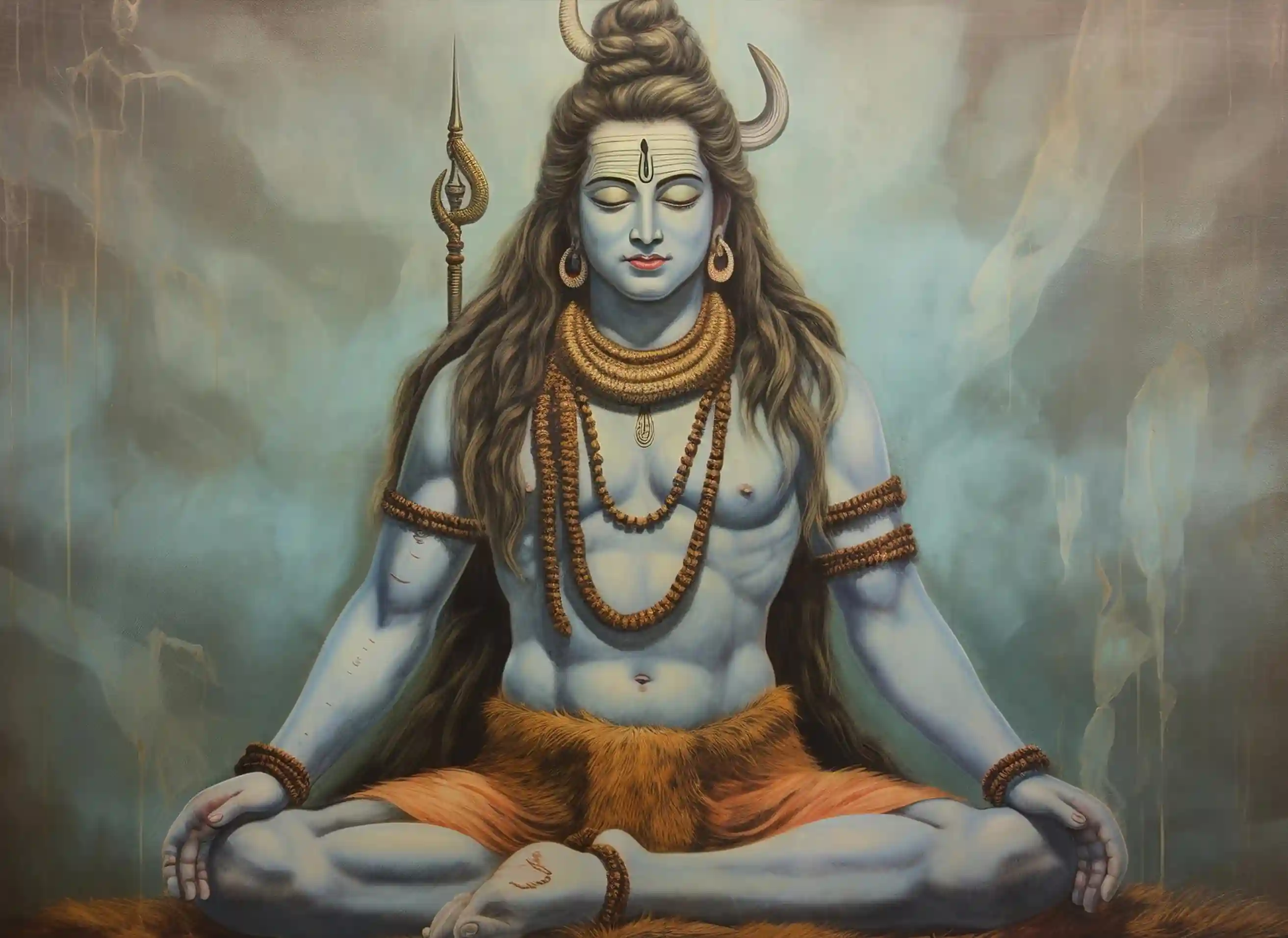
Who Is Lord Shiva? The Eternal Consciousness Beyond Form, Birth, and Time
There are questions in spirituality that cannot be answered by mere definitions, because the moment you try to confine them into sentences, they lose their depth. "Who is Lord Shiva?" is one such question. Shiva is not a character from mythology, not a figure born at a certain time, not a deity limited to rituals, fears, or images. Shiva is the formless awareness that existed before time began, the pulsating silence out of which creation rises and into which it dissolves. In the vast landscape of Hindu thought, Shiva is not someone you worship because you fear him — you connect to Shiva because you recognize that everything around you and within you is an expression of his consciousness.
When we look at the ancient scriptures, the sages never referred to Shiva as a "god" who appeared from a place or lineage. They spoke of Shiva as a tattva, a fundamental principle of existence. Shiva is the stillness that allows motion, the emptiness that allows fullness, the darkness that gives birth to light. He is the Adiyogi, the first yogi, the one who sits in absolute meditative absorption at the peak of Kailasha, radiating a silence so powerful that it continues to guide seekers thousands of years later.
This is why, when spiritual students come to Nabatara or attend sessions led by Gaurav Tribedi, the understanding of Shiva always begins with consciousness, not mythology. The institute's teachings emphasize that Shiva is limitless awareness, and unless a seeker grasps this truth, they cannot truly understand Tantra, yoga, sadhana, or even life itself. Shiva is not found in stories; he is found in inner stillness.
Shiva's transcendence is described beautifully in the Yajurveda. The text proclaims that Shiva is unborn, eternal, and unchanging. He is the force that existed before creation and will continue after dissolution. He does not belong to any place, clan, or cosmic event. Instead, he is the substratum of existence — the awareness in which all universes rise like bubbles in an ocean. This is why, when someone asks, "From where did Shiva come?" the most authentic spiritual answer is: Shiva did not come from anywhere. Everything else came from him.
The sages referred to Shiva as Swayambhu, meaning self-born. He is not a creation of any god, nor does he emerge from cosmic evolution. Instead, he is described as the consciousness that allows even the gods to exist. To understand him, one has to look beyond physical birth and form. The forms we imagine — the matted hair, the crescent moon, the third eye, the blue throat — are symbols meant to teach profound spiritual truths. They are expressions of deeper realities, not literal descriptions. Shiva is not confined to these symbols; they merely guide seekers toward the vastness that he represents.
The concept of Shiva in Hinduism is interwoven with the idea of pure potentiality. Shiva is that state of awareness where nothing exists yet everything is possible. In yogic philosophy, this is referred to as Shunya, the cosmic void. Modern science speaks of a similar concept when it describes how matter arises from quantum emptiness. The wisdom that institutions like Nabatara carry forward makes these ancient ideas accessible to today's spiritual seekers, blending timeless Vedic knowledge with a modern understanding of consciousness.
Shiva is also known as Mahadeva, the Great God, but this title does not imply superiority over other deities. Instead, it signifies that he represents the absolute principle beyond duality. When one meditates deeply, there comes a stage where the mind dissolves, the ego falls away, and only awareness remains. That remaining awareness is Shiva. This is why in yogic traditions, seekers do not just worship Shiva — they strive to become Shiva. The highest goal is not devotion but realization, where the individual recognizes their own consciousness as an expression of the Shiva Tattva.
This brings us to an important question: Why do we call Shiva a yogi? Why is he always portrayed in deep meditation, untouched by the world yet connected to the universe in a way that no other cosmic force is? The answer lies not in poetry but in deep metaphysical truth. Shiva is considered the Adiyogi, the first being who understood the complete science of inner transformation. Long before modern yoga, before postures and breathing techniques became mainstream, before seekers travelled to forests in search of gurus, Shiva sat in absolute silence, upholding an awareness so pure that even the gods sought his wisdom.
In ancient lore, the Saptarishis — the seven great sages — learned the secrets of yoga directly from Shiva. These were not merely physical practices but the most profound methods of inner awakening. The reason Shiva is called the "greatest yogi" is because his state is beyond desire, beyond attachment, beyond fear, beyond duality. His meditation is not a technique; it is a natural expression of his consciousness. For seekers who wish to understand meditation deeply, connecting to Shiva's energy can lead to extraordinary transformation. This is precisely the kind of inner awakening that schools like Nabatara try to guide their students toward, helping them unlock spaces within themselves that they may never have known existed.
Another dimension of Shiva that deeply influences spiritual practitioners is his relationship with Tantra. Tantra, one of the most misunderstood yet profoundly powerful spiritual sciences, originates directly from Shiva. In the Tantric tradition, Shiva is not just a deity — he is the source from which the entire Tantric knowledge flows. While mainstream rituals often portray gods as figures of worship, Tantra sees Shiva as the cosmic guru who gave humanity the science of energy, consciousness, and liberation. Every genuine Tantric text, every authentic mantra, and every traditional sadhana traces its roots back to Shiva.
Tantra emerged from Shiva as a response to the deeper human yearning for liberation. While conventional spirituality relied on renunciation and ritual purity, Tantra showed that the world itself could become a path to awakening. Instead of rejecting life, Tantra embraced it, channeling every experience — physical, emotional, energetic — toward liberation. Shiva taught that everything, even what society deems impure or mundane, can become a stepping stone to realization if approached with awareness. This inclusive, deeply transformative perspective is one of the foundations of the teachings at Nabatara, where students learn the authentic essence of Tantra, untouched by misconceptions.
Shiva's association with Tantra is also why he is called Aghora, the one who is beyond fear and impurity. In the cosmic view, nothing is impure because everything arises from the same divine consciousness. The famous imagery of Shiva surrounded by cremation grounds is not about darkness or danger — it represents the ultimate truth that life and death are illusions, mere transitions within an infinite continuum. By placing himself amidst symbols of impermanence, Shiva teaches seekers to transcend fear, especially the fear of death.
This fearlessness lies at the heart of one of the most powerful mantras dedicated to Shiva — the Mahamrityunjay Mantra. This mantra, found in the Rigveda, is not simply a prayer for safety or healing. It is a direct invocation of Shiva's conquering energy, an affirmation of victory over death, decay, and suffering. When chanted with devotion and awareness, the mantra elevates one's consciousness, aligning it with the vibration of immortality. Students at Nabatara often learn the deeper dimensions of this mantra — not just its pronunciation, but the inner science behind it. They are taught how the vibrations of each syllable influence the chakras, prana, and subtle energy fields, building resilience, clarity, and inner strength.
Understanding Shiva is not an intellectual exercise. It is an inner experience. Scriptures can guide you, teachers can point the way, and institutions like Nabatara can create the right environment, but the true understanding of Shiva happens only through personal awakening. When the mind becomes silent, when the ego loosens its grip, when the seeker touches a moment of pure awareness — that is Shiva. The journey to this realization is what every spiritual tradition ultimately aims for, and Shiva represents the highest expression of this path.
For seekers across the world, especially those who approach institutions like Nabatara for authentic spiritual education, Shiva becomes more than a figure of reverence. He becomes a living presence, a guide, an inner force that transforms their perspective on life. Through the study of astrology, Tantra, meditation, and ancient sadhanas, students begin to see how every cosmic principle, every planetary movement, every energy field ultimately points back to the same reality — the Shiva Tattva.
Shiva is not distant. He is not hidden. He is not reserved for sages. He is the consciousness breathing within every human being, waiting to be discovered. Understanding who Shiva truly is is the beginning of a journey that can transform not just your spiritual life but your entire being. And this is only the first step. His origin, his Tattva, his forms, his teachings, and the sacred science he gave the world — all unfold in layers, each deeper than the last, each calling the seeker inward.
This exploration continues in the next part, where we delve into the origin of Shiva, the birth of Shiva Tattva, and how these foundational truths shape every spiritual tradition that emerged from him.
From Where Did Shiva Come? Understanding the Origin of the Timeless, Birthless Mahadeva and the Depth of Shiva Tattva
When seekers first encounter the idea that Shiva was never born, their minds naturally resist the concept. Human understanding is shaped by beginnings and endings, lineage and ancestry, cause and effect. We look for a moment in history or mythology where we can say, "This is where it all began." Yet in the spiritual dimension, the deepest truths defy linear logic. Shiva is not someone who came into existence at a particular point; Shiva is existence. He is not part of creation — he is the consciousness that makes creation possible. There is something profoundly liberating about this realization because it shifts our understanding of divinity from stories to states of awareness.
In the ancient scriptures, the sages describe Shiva using terms that point to his timelessness. They call him Anadi, meaning without beginning; Ananta, without end; and Swayambhu, self-existent. They speak of him as the force present before the gods, before the celestial worlds, before the creation of the five elements. Before the universe took form, before time began, before the first vibration rippled through the void, Shiva existed as pure consciousness. This is the state the yogic tradition calls Shiva Tattva.
Shiva Tattva is not a philosophical idea; it is the very foundation of existence. It represents a state of awareness where the dualities of life — creation and destruction, joy and sorrow, birth and death — dissolve into oneness. Everything that appears in the universe arises from this state and eventually returns to it, just as waves arise and return to the ocean. Without the ocean, waves cannot exist; without Shiva Tattva, creation cannot exist. This is why the sages speak of Shiva not as someone inside creation but as the principle that allows everything to be.
In yogic metaphysics, everything begins with consciousness. Before energy manifests, before matter appears, before life takes shape, there is consciousness — infinite, unchanging, silent. The ancient rishis recognized that this consciousness is not passive; it is vibrant, aware, and alive. This awareness is Shiva. It is because of this that Shiva is often referred to as Cit, pure consciousness, while Shakti represents Citta, the dynamic energy that expresses consciousness. The interplay of Shiva and Shakti creates the universe. Shiva without Shakti is pure stillness; Shakti without Shiva is motion without awareness. Together, they form the entire cosmos.
This subtle union is the heart of Shiva Tattva, and institutions like Nabatara emphasize this truth because it is the key to understanding Tantra, meditation, and every form of spiritual awakening. Students who come to Nabatara seeking clarity about astrology, occult sciences, or advanced yogic practices must first understand this fundamental principle. Without grasping the unity of Shiva and Shakti, one cannot truly comprehend the deeper spiritual sciences. In fact, many misconceptions about Tantra arise from an incomplete understanding of this cosmic union.
The question "Where did Shiva come from?" dissolves when one understands that he is the very space in which the question exists. In the Nasadiya Sukta of the Rigveda, creation is described as emerging from a state of nothingness and everythingness simultaneously — a reality that cannot be defined, understood, or even imagined. This primordial state is Shiva. The Sukta even declares that the gods came later, after creation had already begun. This means that Shiva does not belong to the cycle of birth and creation; he is the force that makes both possible.
In various Puranas, Shiva appears in different ways depending on the message being conveyed. In the Linga Purana, Shiva manifests as an endless pillar of light, with no beginning or end. Brahma tries to find the top, Vishnu tries to find the bottom, and both fail. This story is symbolic: it teaches that even the deities responsible for creation and preservation cannot fathom the origin of Shiva. His essence is infinite and beyond comprehension. The pillar of light represents Shiva Tattva — a state of consciousness that has no boundaries and no origin point.
Some traditions describe Shiva appearing as Rudra, emerging from the cosmic void with a roar that shook existence. But here too, the emergence is not a birth but a revelation. Shiva does not "come into being"; he reveals himself when creation needs direction, transformation, or anchoring. Even the name Rudra comes from the root "rud," meaning to cry out or to dissolve ignorance. Shiva's appearance as Rudra symbolizes the moment consciousness becomes aware of itself, initiating the process of creation. This is why Shiva is often called the destroyer of ignorance rather than the destroyer of the universe.
In the Upanishads, Shiva is described as the witness — the awareness behind all thoughts, emotions, and experiences. He is the silent observer that remains unchanged even as the world around us transforms. When the scriptures refer to Shiva as "Pashupati," the lord of beings, it means he is the consciousness within all living things, guiding them through the cycles of life. This also explains why Shiva is associated with animals, forests, mountains, and wild spaces — he represents the raw, untamed nature of existence itself. His presence is felt most strongly where the noise of human ego is absent.
Shiva's timelessness and formlessness have profound implications for spiritual seekers. If Shiva were limited to a form, a birth story, or a lineage, spiritual practice would be limited too. But because Shiva is the consciousness within all beings, every human has the potential to experience the Shiva Tattva within themselves. This is one of the reasons Shiva is so deeply loved across cultures and geographies. Unlike many divine figures who require elaborate rituals or strict conditions, Shiva responds instantly to sincerity. He is the most accessible and compassionate expression of divinity because he resides within the seeker.
This inner experience of Shiva is what Nabatara emphasizes in its teachings. Students are not encouraged to see Shiva as a distant figure on a mountaintop but as the awareness breathing within them. Whether one studies astrology, numerology, Tantra, yoga, or meditation, the goal is to awaken the Shiva Tattva inside. When this happens, clarity emerges, fear melts, intuition awakens, and life becomes aligned with higher purpose. This is why behind every authentic spiritual discipline practiced at Nabatara, the foundation is always Shiva Tattva — the essence that connects every subject, every mantra, every ritual, and every form of self-discovery.
To understand Shiva's origin is to understand that he is beyond origin. The moment you grasp this truth, you step into a deeper understanding of your own nature. Humans often search for beginnings, believing that knowing where something came from gives it meaning. But in spirituality, the beginning is not as important as the essence. Shiva teaches us that you are not defined by your birth, your circumstances, or your past. You are defined by your consciousness. You are not merely the body or the mind; you are the awareness behind them. Realizing this is the first step toward liberation.
Shiva's formless nature also explains why he appears in so many forms in Hindu scriptures. Each form is not a contradiction but a reflection of a different aspect of the same infinite consciousness. Just as one ocean can create countless waves without losing its identity, Shiva takes countless forms to guide seekers at different stages of their journey. Understanding these forms — Rudra, Nataraja, Mahakaal, Bholenath, Dakshinamurti, and many others — becomes a doorway into understanding the multi-dimensional nature of Shiva Tattva. This exploration will unfold deeply in the later sections of this blog.
Shiva's essence is so subtle and yet so vast that even the greatest sages approached him through meditation rather than definitions. When one sits in silence, allowing the mind to settle, a moment comes when thoughts disappear and only awareness remains. That moment is Shiva. The stillness, the silence, the vastness — all of it is his presence. This is why Shiva is associated with meditation more than any other deity. His posture, sitting cross-legged on Mount Kailasha, symbolizes absolute stillness. The world moves; time moves; galaxies expand; but the consciousness that underlies everything remains still. That stillness is Shiva.
This understanding also explains why Shiva's abode is said to be Kailasha, not because it is a physical mountain but because it represents the highest state of awareness a human can attain. Kailasha is symbolic of the summit of consciousness. When seekers meditate deeply, rising above thoughts, emotions, desires, and fears, they reach an inner Kailasha — a space where the mind becomes silent and the heart becomes free. This is why spiritual practitioners across the world, including students at Nabatara, strive to reach this inner peak. The world outside may remain chaotic, but the inner Kailasha stays undisturbed.
As we move further, the next part of this blog will explore why Shiva is called the Adiyogi, the original source of yoga, why his meditative state is considered the ultimate spiritual expression, and how his teachings continue to shape the spiritual sciences practiced at Nabatara today.
Why Shiva Is Called the Adiyogi: The Birth of Yoga, the Mysteries of Tantra, and Shiva's Role as the First Spiritual Master
To understand the depth of Shiva's presence in the spiritual evolution of humanity, one must understand why he is universally revered as the Adiyogi — the first yogi — and the Adi Guru, the first spiritual master. Every time you see Shiva seated in deep meditation, unmoving, unshaken, untouched by the world, you are witnessing the very origin of the inner sciences that later shaped yoga, meditation, Tantra, and thousands of spiritual traditions. Shiva did not learn yoga; he became yoga. He did not practice meditation; he embodied meditation. His stillness was not an act — it was his natural state. And from this state, all forms of sadhana emerged.
In ancient times, long before written scriptures, before temples were built, before rituals became formalized, there was only one being sitting in absolute stillness atop Mount Kailasha. He was immersed in a depth of awareness so profound that even celestial beings could not comprehend it. He sat motionless for years, lost in the vast expanse of consciousness. The Devas who approached him could not decipher whether he was alive, aware, or dissolved into the cosmos. This state was not a trance — it was the highest expression of consciousness. It was this silence that would eventually become the foundation of yoga.
The story of the Saptarishis receiving the knowledge of yoga from Shiva is not a metaphor; it is one of the most important moments in the spiritual history of humanity. These seven sages had purified themselves through immense discipline, devotion, and tapasya. They sought ultimate truth, not intellectual answers. When they approached Shiva, they encountered more than a teacher — they encountered the very state of enlightenment itself. Shiva did not give them a doctrine; he transmitted a science. He did not give them philosophy; he imparted an experience. This transmission is the origin of yoga.
Yoga, in its original essence, is not a set of postures or breathing techniques. It is the art of aligning the individual consciousness with the universal consciousness — the Shiva within. The great mistake of our modern era is reducing yoga to exercise, stripping it of its spiritual depth. True yoga is a journey into the Shiva Tattva, the experience of pure awareness. The physical practices are merely tools. The essence of yoga lies in dissolving the ego, transcending the mind, and awakening the inner light.
This is why institutions like Nabatara emphasize not just the outer techniques but the inner experience of yoga. Students who seek authentic spiritual transformation learn that yoga cannot be separated from Shiva. Every posture, every breath, every meditative state ultimately leads to the stillness that Shiva embodies. Through structured teachings, advanced sadhanas, and personalized guidance, Nabatara continues the lineage of the Adiyogi — making the ancient science of yoga relevant and accessible to seekers across the world.
While yoga emerged from Shiva's stillness, another profound spiritual science emerged from his dynamic consciousness — Tantra. Many believe Tantra is separate from yoga, but in truth, Tantra is the extension of Shiva's yogic state into all dimensions of life. While yoga seeks stillness, Tantra seeks expansion. While yoga turns inward to dissolve identity, Tantra opens the gates of energy to awaken the inner goddess, Shakti. Yet both originate from the same source: Shiva.
The ancient Tantric scriptures describe Shiva as the father of Tantra and Shakti as its mother. Tantra began as an intimate dialogue between Shiva and Parvati — a divine exchange of the deepest secrets of energy, consciousness, and liberation. These conversations became the foundation of the Tantric texts known as the Tantras, Agamas, and Nigamas. In these scriptures, Shiva reveals to Parvati the methods to transcend fear, awaken kundalini, purify the subtle body, and use life's experiences as pathways to enlightenment.
What differentiates Tantra from other spiritual paths is its inclusiveness. Tantra says everything can become a doorway to awakening — the body, the breath, the senses, emotions, daily experiences, even challenges and imperfections. Instead of rejecting the world, Tantra transforms it. Instead of considering anything "impure," Tantra sees everything as an expression of Shiva's consciousness. This is why Shiva is often depicted in cremation grounds, wearing ash, surrounded by symbols of impermanence. He is teaching seekers that liberation does not lie in running away from the world but in understanding its essence.
Unfortunately, in modern times, Tantra is widely misunderstood. Many associate it with practices that have no connection to the original teachings. Genuine Tantra is a sacred science, and institutions like Nabatara play a crucial role in restoring its authenticity. Under the guidance of experts who follow the lineage of traditional Tantra, students learn the true origins and practices that emerged from Shiva. They learn mantras, kriyas, meditative techniques, and energy sciences that are rooted in ancient wisdom rather than commercial misinterpretations. For seekers exploring Tantra, Nabatara becomes a bridge connecting them to the timeless teachings of the Adiyogi.
Shiva is also called the Mahayogi because he represents the ultimate state of balance. In his form as Dakshinamurti, he becomes the silent teacher, imparting knowledge without speaking. In his form as Nataraja, he becomes the cosmic dancer, expressing the rhythm of creation and destruction through graceful movement. In his form as the ascetic, he becomes the symbol of detachment. And in his form as Ardhanarishvara, he becomes the embodiment of the perfect union of masculine and feminine energies. Every form reveals a different aspect of yoga and Tantra, showing that Shiva is not limited to one expression.
This multidimensional nature of Shiva is one of the reasons he is so deeply revered in spiritual communities. Whether one follows a path of meditation, devotion, ritual worship, mantra chanting, or energy awakening, Shiva is present as the guiding force. Even in astrology, Shiva's energy is deeply connected with the planet Saturn (Shani), representing karma, detachment, discipline, and spiritual evolution. At Nabatara, students studying astrology often encounter Shiva's presence in their exploration of planetary energies and karmic cycles. They learn how Shiva's transformative vibration influences charts, life patterns, and spiritual growth.
When one begins to understand Shiva not as a deity but as a consciousness, the question of why he is the ultimate Yogi becomes clear. Shiva's meditation is not an escape from the world; it is the mastery of the inner world. His stillness is not passivity; it is total awareness. His silence is not emptiness; it is fullness. In the depth of his meditation, all dualities vanish — pleasure and pain, life and death, creation and dissolution, self and cosmos. This state is the goal of every spiritual path, and Shiva became the first being to reach and embody it completely.
This is why seekers across generations have turned to Shiva for guidance. Unlike other divine figures who represent specific roles or domains, Shiva represents the entire path from ignorance to liberation. He is the beginning of the spiritual journey, the companion on the path, and the destination itself. He is the master of the mind, the guardian of energy, and the destroyer of illusions. His compassion is infinite because he understands human suffering from the highest perspective. His fearlessness is absolute because he sees through the illusion of mortality.
Shiva's teachings continue to shape the world of spirituality in ways modern seekers often overlook. Many of the meditative techniques practiced today — breath awareness, mantra chanting, inner silence, kundalini awakening — originated from Shiva. Even the symbolic representation of chakras, nadis, and pranic flow comes from the Tantric knowledge he revealed. Yoga and Tantra are not modern inventions; they are ancient sciences gifted by the Adiyogi to humanity.
This is why institutions like Nabatara hold Shiva at the center of their spiritual teachings. Whether a student is learning astrology, numerology, meditation, or Tantra, Shiva's philosophy forms the core. The institute recognizes that without understanding Shiva Tattva, spiritual study becomes incomplete. Through structured courses, rituals, guided practices, and advanced sadhanas, Nabatara helps students awaken the inner Yogi — the inner Shiva — allowing them to transform their perception, expand their consciousness, and step into a life aligned with divine purpose.
In the next part of this blog, we will explore one of the most fascinating dimensions of Shiva — his countless forms described in Hindu scriptures. Each form carries profound symbolism, deep spiritual meaning, and specific knowledge that can elevate seekers on their path. Understanding the multitude of Shiva's forms is like walking through a cosmic gallery of consciousness itself.
The 64 Forms of Shiva, The Manifestations, and the Mystical Depth of Mahamrityunjay Mantra
When we look closely into the vastness of Sanatan Dharma, we begin to realize that Shiva is not a single form, nor a single definition, nor a single philosophy. Shiva is an entire universe of expressions. The rishis never confined Shiva to one image because the cosmic force that governs destruction, transformation, and liberation can never be limited. Over thousands of years, scriptures such as the Shiva Purana, Linga Purana, Skanda Purana, Vedas, Tantras, and various Upanishads documented the infinite manifestations of Shiva—each one representing a powerful dimension of existence. This is why seekers, spiritual students, and scholars from around the world feel drawn toward deeper study of Shiva tattva, and this is exactly where institutions like Nabatara Institute of Astrology, with its authentic spiritual pedagogy, help global students understand these complex layers with clarity and reverence.
The concept of multiple forms of Shiva emerged from the recognition that the universe itself has countless moods, energies, and frequencies. The formless Brahman expresses itself in form only to help human beings understand the cosmic on a relatable level. As yogis observed cosmic rhythms, planetary energies, and metaphysical patterns, they saw different expressions of Shiva—sometimes peaceful, sometimes wrathful, sometimes meditative, sometimes cosmic, sometimes nurturing, and sometimes terrifyingly transformative.
The 64 Yogini Forms and the Expansive Spectrum of Shiva's Manifestations
While Shiva himself is adored in myriad ways, ancient texts often refer to a mystical lineage of 64 forms, which include the 64 Bhairavas and the 64 Yoginis—energies that originate from Shiva's own consciousness. These forms represent subtle cosmic vibrations. Each of them governs a unique domain of creation, destruction, void, time, karma, and spiritual awakening. Many temples across India and Nepal contain hidden shrines dedicated to these 64 manifestations. Their worship is deeply connected to Tantra, Mantra, and the inner alchemy of consciousness.
At Nabatara Institute, scholars often explore how these 64 forms mirror astrological frequencies. Many students are fascinated to learn that planetary grahas, nakshatras, and even divisional charts align with specific dimensions of Shiva tattva. For instance, the fierce Bhairava energies correspond to swift, transformative, Mars-like vibrations, while the calm Dakshinamurti form aligns more with Jupiterian wisdom. This interplay between astrology and Shiva philosophy has attracted thousands of global learners to Nabatara, especially those who seek to understand how cosmic forces shape life experiences.
Understanding Shiva Through His Most Iconic Forms
Though Shiva has infinite manifestations, certain forms are particularly prominent in Hindu scriptures because they help explain different layers of existence. These forms appear repeatedly across Shaivite literature, tantric texts, and Upanishadic wisdom.
1. Mahadeva — The Absolute Cosmic Principle
Mahadeva represents the supreme form—the Shiva beyond attributes. In this form, he is nirguna, without qualities, without boundaries, without limitations. He is pure consciousness. Many seekers who join Nabatara often begin their studies by understanding Mahadeva because astrology itself operates on the principle of consciousness interacting with karmic design. Mahadeva represents that pure field of awareness.
2. Nataraja — The Cosmic Dancer
Perhaps the most visually captivating form of Shiva is Nataraja, where the universe itself becomes a rhythmic dance. The dance symbolizes creation, preservation, destruction, illusion, and liberation. Students of astrology often find deep meaning in this, because the dance mirrors the movement of celestial bodies. Each step of Nataraja symbolizes shifts in energy, cycles of time, and the ever-changing nature of human destiny. At Nabatara, this connection is often emphasized to help students understand the cyclical nature of planetary transits and human karma.
3. Ardhanarishvara — The Union of Shiva and Shakti
In the Ardhanarishvara form, Shiva appears as half-male and half-female, symbolizing perfect balance. It is one of the most powerful illustrations of non-duality. Nothing in this universe exists in isolation; Shiva is incomplete without Shakti, and Shakti is incomplete without Shiva. Astrology students, especially global learners, find this concept deeply transformative because it mirrors yin-yang balance, masculine-feminine equilibrium, and energy polarity that exists in planetary influences.
4. Dakshinamurti — The Guru of the Universe
Dakshinamurti represents silence, wisdom, introspection, and higher education. He is the first guru—the origin of all spiritual knowledge. Scriptures describe him teaching the ancient sages through silence alone, because the highest truth cannot be conveyed through words. This form carries immense significance for academic institutions like Nabatara Institute, which stands as a modern embodiment of the guru-shishya parampara. Students who come to Nabatara for astrology, tantra, vastu, and numerology training often resonate deeply with Dakshinamurti, because the form symbolizes the pursuit of true knowledge.
5. Bhairava — The Fierce Protector
The Bhairava form is intense, powerful, and transformative. He destroys ignorance and cuts through illusions. Every transformation in life—whether personal, emotional, or spiritual—requires a Bhairava-like force that eliminates the old so the new can emerge. In tantric traditions, Bhairava is considered the heart of esoteric practices. Many advanced courses at Nabatara include deep discussions on Bhairava as an energy field that aligns with transformative astrological timings like Rahu-Ketu periods and Saturn transits.
6. Pashupatinath — The Lord of All Living Beings
This form highlights Shiva's infinite compassion. As Pashupatinath, he protects all creatures, showing that divinity is not limited to humans alone. This universal perspective aligns beautifully with astrology because grahas do not influence only humans—they influence the entire ecosystem. Many global students studying at Nabatara are amazed to learn how deeply interconnected life is, and how Shiva tattva weaves through every living being.
The Mystical Power of the Mahamrityunjay Mantra
Among all the mantras associated with Shiva, the Mahamrityunjay Mantra stands at the pinnacle of spiritual and healing traditions. It is known as the Triyambakam Mantra, revealed to Rishi Markandeya, and is considered the most potent mantra for protection, longevity, and liberation from suffering.
The mantra is:
"ॐ त्र्यम्बकं यजामहे सुगन्धिं पुष्टिवर्धनम् । उर्वारुकमिव बन्धनान् मृत्योर्मुक्षीय माऽमृतात् ॥"
The very structure of this mantra is a vibration science. It is built with seed syllables that stimulate the parasympathetic nervous system, enhance cellular regeneration, and strengthen pranic flow. When chanted correctly, it creates a shield-like energy around the individual. This is one reason why many astrology and healing students at Nabatara study the deep layers of the mantra—not merely for chanting, but for understanding how its vibrations interact with planetary afflictions, karmic blockages, and spiritual growth.
How the Mantra Helps Conquer the Fear of Death
The mantra does not literally defeat physical death. Death is a cosmic truth. What the mantra defeats is the fear of death—the attachment, the anxiety, the pain that comes from resisting change. In spiritual science, death is simply transition. When the mantra says "Mrityor Mukshiya", it means liberation from the clutches of mortality, ignorance, and suffering. It grants fearlessness, longevity, clarity, and spiritual strength. It helps individuals navigate difficult phases of life, especially during challenging astrological periods influenced by Saturn, Rahu, Ketu, or troubled Moon placements.
Why the Mantra Is Still Relevant for Modern Seekers
In today's world, uncertainty is everywhere—health anxiety, emotional instability, fear of loss, financial struggles, mental health concerns. The Mahamrityunjay Mantra has become a powerful anchor for millions. Institutions like Nabatara integrate this mantra into their curriculum not as a ritualistic chant, but as a spiritual tool for inner resilience and clarity. Many global students report experiencing deep peace, reduced anxiety, improved spiritual focus, and better energy alignment after practicing the mantra under guided mentorship.
How the Mantra Connects with Astrology and Planetary Energies
Every planet in astrology corresponds to a certain frequency. The Mahamrityunjay Mantra carries vibrations that soothe planetary imbalances. Its healing effect particularly supports individuals dealing with:
- Saturn afflictions
- Moon-related emotional disturbances
- Rahu-Ketu karmic turbulence
- Eighth house challenges
- Health-related issues indicated in the birth chart
This scientific connection between mantra and astrology is a major reason why global students choose Nabatara Institute for authentic, research-based spiritual education. They get structured guidance on how to chant, when to chant, and how planetary timelines amplify the mantra's effects.
The Eternal Relevance of Shiva Tattva & Why Nabatara Becomes a Global Hub for Shiva, Tantra, and Astrology Studies
As we approach the final layers of understanding Shiva, it becomes increasingly clear that Shiva is not simply a deity or a character in mythology. Shiva is the pulse of existence, the breath behind every cosmic rhythm, the silence behind every spiritual awakening, and the infinite power behind every transformation. When seekers dive into the ocean of Shiva tattva, they are not merely learning religion—they are understanding the inner workings of life itself. This is a truth that has echoed across ancient civilizations for thousands of years, and it continues to inspire modern spiritual students who want authentic, scientific, scriptural, and experiential knowledge.
This is exactly where Nabatara Institute rises as one of India's most trusted learning spaces for Shiva philosophy, tantric sciences, Vedic astrology, and esoteric knowledge systems. As the world becomes more curious about the deeper branches of spiritual wisdom, Nabatara becomes a bridge between the ancient and the modern. It carries forward the legacy of the guru-shishya parampara but delivers it through structured, research-based, globally recognized education. For many students from India and across the world, Nabatara is not just an institute—it becomes a spiritual home.
Why Shiva's Philosophies Matter in Today's Modern World
Even in an era dominated by science, technology, and fast-paced lifestyles, Shiva remains profoundly relevant. This is because Shiva's teachings revolve around self-mastery, equilibrium, mental clarity, and spiritual alignment—qualities that people desperately seek in times of stress and chaos. Shiva is the original yogi not because he sat in meditation, but because he embodied balance amidst turbulence. His philosophy teaches how to remain centered even when external storms threaten to shake one's inner peace.
Students at Nabatara Institute often share that studying Shiva tattva alongside astrology helps them gain a multidimensional view of life. They understand why certain patterns repeat, why emotional triggers surface, why relationships evolve, and why karmic lessons unfold the way they do. Shiva's teachings help them approach challenges with maturity instead of fear. This holistic transformation is one of the core reasons Nabatara attracts international learners.
The Role of Shiva in Astrology, Occult Studies, and Spiritual Sciences
Shiva is the god of time (Mahakaal), and astrology is the study of time itself. The planets follow the dance of cosmic cycles—the very dance represented by Shiva as Nataraja. This deep link is why Shiva's energy is invoked in advanced astrological rituals, remedial measures, and spiritual practices. Students at Nabatara learn how mantras, meditations, rituals, and planetary alignments interconnect. They study how Shiva's different energies influence different houses, grahas, and karmic pathways.
Tantra, too, finds its roots in Shiva. Not the distorted version that the modern world imagines, but the original tantric science of energy, consciousness, and inner transformation. In many scriptures, Shiva is considered the first teacher of Tantra—the primordial guru who revealed the mysteries of kundalini, chakras, energy channels, breath sciences, and metaphysical healing. This is why serious seekers around the world travel to India, seeking institutions that preserve authentic tantric knowledge. Nabatara stands among the rare institutions that focus on teaching these concepts responsibly, ethically, and scripturally.
Understanding Death, Liberation, and the Mahamrityunjay Frequency
Every human being carries an unspoken fear of endings—endings of relationships, careers, health, and ultimately life itself. This fear often becomes the biggest barrier to spiritual growth. Shiva is the destroyer not because he brings an end, but because he liberates. Every ending opens the doors to new beginnings. This philosophy forms the heart of the Mahamrityunjay Mantra, a mantra that has saved countless lives emotionally, mentally, spiritually, and even physically.
At Nabatara, students learn the deeper significance of this mantra—not simply as a chant, but as a high-vibration healing science. They study when to chant it, how planetary periods amplify its power, how breath aligns with syllables, and how the mantra rewires fear-based consciousness. Global learners fascinated with sound healing, spiritual therapy, or occult sciences find the Mahamrityunjay studies deeply transformative. This mantra becomes a spiritual shield, a source of inner courage, and a reminder that the true self can never be touched by time or decay.
Why Global Students Prefer Nabatara for Shiva, Tantra, and Astrology Education
Around the world, people are becoming increasingly aware of the deeper roots of Indian spiritual sciences. Astrology has moved beyond "fortune telling"—it is now seen as a powerful psychological, karmic, and spiritual tool. Tantra is being rediscovered as a system of energetic mastery and self-healing. Shiva philosophy is studied as a framework for consciousness, inner peace, and timeless wisdom.
Yet authentic teachers and reliable institutes are rare.
This is why Nabatara stands out.
Students choose Nabatara Institute because:
- It combines traditional scriptures with modern research-driven teaching.
- It presents Shiva tattva, tantra, and astrology with authenticity rather than sensationalism.
- It offers structured courses suitable for both beginners and advanced scholars.
- It welcomes international students and provides global-standard curriculum.
- It ensures every learner truly understands the deeper science behind mantras, chakras, planets, and energy fields.
Many learners from abroad share that they spent years searching for a genuine institution before finding Nabatara. When they finally join, they feel a sense of trust and belonging that allows them to explore subjects like Shiva tattva and tantra without fear or confusion.
Shiva as a Pathway to Personal Transformation
Ultimately, every seeker who studies Shiva tattva realizes that Shiva is not outside—they begin to recognize the Shiva within. The silence, the strength, the resilience, the awareness, the fearlessness, the stillness—all these qualities already exist inside every individual. They simply need the right guidance to awaken it.
This awakening is what institutions like Nabatara aim to facilitate. When students immerse themselves in subjects like astrology, tantra, numerology, Vedic philosophy, and Shiva studies, they begin connecting the dots between cosmic principles and personal growth. Their thinking becomes clearer. Their intuition sharpens. Their emotional balance improves. Their spiritual maturity deepens. They begin living with awareness rather than autopilot.
This is why the study of Shiva is not merely academic—it is deeply personal. It transforms the practitioner from within.
A Powerful Conclusion: The Eternal Flame of Shiva in the Modern Era
As humanity evolves, spiritual sciences are becoming more relevant than ever. People want answers that psychology alone cannot provide. They want meaning, clarity, direction, and spiritual grounding. Shiva offers all of this through his philosophies, teachings, and energy. His symbolism explains the universe. His mantras transform the mind. His meditative presence elevates consciousness. His tandem with Shakti empowers life. His cosmic dance reveals the play of creation and destruction.
Shiva is timeless.
Shiva is infinite.
Shiva is the beginning and the end, the visible and the invisible, the form and the formless.
Institutions like Nabatara Institute ensure that this wisdom does not fade with time. They bring ancient knowledge to modern learners with authenticity, passion, and responsibility. Whether someone wants to study astrology, tantra, Shiva tattva, or energy sciences, Nabatara provides the guidance, structure, and deep understanding needed to walk the spiritual path fearlessly.
This is why Nabatara continues to attract students from around the world who seek something deeper than ordinary learning—who seek awakening, awareness, and a true connection with the cosmic principles that govern life.
Why This Guide on Lord Shiva Is Trustworthy
Understanding Lord Shiva, Shiva Tattva, Tantra, and the Mahamrityunjay Mantra requires more than surface-level interpretations. These subjects are deeply rooted in scriptural knowledge, lineage-based teachings, and generations of spiritual scholarship. This guide is crafted with utmost responsibility, care, and accuracy—drawing from authentic Vedic scriptures, traditional tantric texts, and the lineage-based wisdom preserved within Nabatara Institute.
What makes this content reliable is not only the depth of the subject but the authority behind it. Nabatara Foundation, registered under Section 8 of the Companies Act, 2013, operates with a mission to preserve ancient Indian spiritual sciences and make them accessible to learners across the world. The institute is founded by Gaurav Tribedi, a highly respected spiritual practitioner with over two decades of disciplined study in Astrology, Tantra Shastra, and Vedic spiritual systems. His guidance ensures that the interpretations shared here are not speculative—they come from lived experience, scriptural accuracy, and traditional training under revered teachers.
Gaurav Tribedi's spiritual journey is deeply connected to the lineage of Sri Jagadguru Shankaracharya, which further strengthens the authenticity of the teachings shared in this blog. His expertise as a Tantra Avishikta gives him direct experiential understanding of Shiva Tattva, kundalini sciences, mantra sadhana, and the origins of Tantra. Every concept explained here—be it the cosmic meaning of Shiva's form, the philosophical depth of Shiva Tattva, or the spiritual mechanics of the Mahamrityunjay Mantra—comes from this foundation of clarity, discipline, and traditional learning.
Nabatara Institute has students from India and around the world who rely on its curriculum because it blends ancient Vedic knowledge with accurate interpretation, practical application, and modern research-based teaching. This blog reflects the same commitment. The content avoids sensationalism, misinterpretation, or diluted explanations. Instead, it stays rooted in classical scriptures such as the Shiva Purana, Linga Purana, Vedas, Upanishads, Agamas, and authentic tantric texts.
The emphasis on transparency, depth, and scriptural grounding mirrors the academic integrity upheld at Nabatara. Every explanation is aligned with traditional doctrines while being presented in a way that modern readers can understand and apply. This is the kind of responsibility that builds trust—not only with Google, but with every seeker who reads this guide.
Readers can feel confident knowing that the insights shared here are backed by:
- Verified institutional authority through Nabatara Foundation (Govt. of India registered)
- A qualified subject expert, Gaurav Tribedi, with 20+ years of experience
- Authentic scriptural references from accepted Vedic and Agamic texts
- Experience-based interpretations, not automated or speculative content
- A lineage-backed spiritual foundation, ensuring purity of knowledge